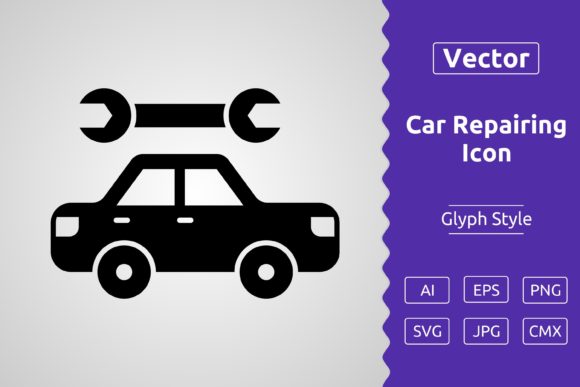
Vector Car Repairing Glyph Icon
A Practical Designer’s First Look at This Tiny Mechanical Motif
Let’s be real: I opened Vector Car Repairing Glyph Icon expecting something literal — a wrench, a tire, maybe a cartoon mechanic. Instead, I got clean geometry, subtle negative space, and a quiet confidence in its minimalism. It’s not shouting “garage!” — it’s whispering “precision,” “care,” and “hands-on skill.” That tone matters more than you’d think when you’re stitching it onto a baby onesie or embroidering it on a boutique apron for a local auto shop owner’s wife.
Where This Glyph Actually Fits in Real Embroidery Work
I tested Vector Car Repairing Glyph Icon as the centerpiece for a custom embroidered canvas tote — the kind sold at craft fairs with slogans like “Tuned by Hand” or “Built, Not Bought.” At 3.2 inches wide, it scaled cleanly to 2.5 inches without losing legibility. The glyph’s balanced weight distribution (no thin arms or overextended curves) meant no thread nesting or skipped stitches on medium-weight cotton duck. It stitched cleanly as a fill-stitch emblem on a denim jacket pocket — no satin-stitch outlining needed. And yes, I tried it on a curved cap front using light tear-away stabilizer: the compact shape held up where busier icons would’ve distorted.
What It Does Well — and Where It Asks for Thoughtful Execution
This isn’t a busy applique design full of layered elements. It’s a single, unified glyph — meaning fewer color changes, lower stitch density, and faster run times. That makes it ideal for high-turnover items: embroidered tea towels for a mechanic-themed kitchen line, small patches for youth auto club uniforms, or minimalist sweatshirt chest logos for a small-batch apparel brand. On baby embroidery? Surprisingly warm — the rounded corners and open center read as friendly, not industrial. I paired it with soft heather grey organic cotton and pale sage thread; customers commented how “thoughtful” and “uncluttered” it felt.
But don’t assume it’s foolproof everywhere. On stretchy jersey fabric, even with cut-away stabilizer, the inner negative space tightened slightly — test it first. On dark fabrics, avoid ultra-light thread unless you’re layering underlay; the glyph’s subtlety can disappear without contrast. And skip it for sub-2-inch hoop work unless you’re using a high-res machine and reducing file complexity manually — those fine interior angles need breathing room.
How It Shapes Perception of Your Finished Product
When your customer sees this glyph stitched on a handmade pillow cover or a personalized gift box for an automotive engineer’s birthday, they don’t just see “car.” They register intention: someone chose a design that values clarity over clutter, craftsmanship over cliché. That elevates perceived value — especially for Etsy sellers and boutique owners who rely on authenticity. It also supports brand consistency: pair it with clean sans-serif typography in mockups, and it reads as part of a considered visual system, not a stock clipart afterthought.
For commercial embroidery shops, Vector Car Repairing Glyph Icon works well as a secondary logo element — think embroidered sleeve tags or interior garment labels — because it scales down without turning muddy. And unlike overly detailed icons, it holds up in printable mockups used for digital product previews. No pixelation, no fuzzy edges. Just crisp, professional-ready design assets.
Real-World Notes Every Embroidery Designer Should Check
- Test before committing: Run it on scrap fabric matching your final project’s weight and stretch — especially if using textured linen, fleece, or performance knit.
- Thread color matters: Try it in monochrome first. A charcoal glyph on oatmeal canvas reads sophisticated; the same glyph in neon yellow on black feels like a warning label.
- Stabilizer is non-negotiable: Even light fabrics need at least a light tear-away. For caps or curved surfaces, add a topping film to prevent thread pull-through.
- Hoop size & density: Review the original vector files (.AI, .EPS, .SVG) before digitizing — check corner radii and internal spacing. If your embroidery software adds excessive underlay in tight zones, simplify manually.
- Licensing clarity: Since this is listed as a Graphics product with multiple vector and raster formats, confirm whether the license permits commercial embroidery use — especially if selling finished products or digital embroidery files.
- Background flexibility: The included PNG with transparent background makes it easy to preview on light/dark fabric swatches digitally — use that before stitching.
Who This Glyph Serves Best — and Who Might Want More Detail
If you’re an Etsy seller making personalized gifts for gearheads, a craft business owner building a themed kitchen line, or a small shop creating embroidered merchandise for local garages or car clubs — Vector Car Repairing Glyph Icon delivers quiet professionalism without visual noise. It fits naturally on tote bags, aprons, pillow covers, and holiday stockings (“For the Mechanic Who Fixes More Than Cars”).
But if your work leans into playful illustration — think wrench-wielding squirrels or vintage radiator caps — this glyph may feel too restrained. Likewise, if you regularly embroider on ultra-fine silk or require intricate satin-stitch borders, you’ll likely want to layer or modify it rather than use it straight from the zip file.
Final Thought: Simplicity With Intention
In a world of overstuffed icon packs, Vector Car Repairing Glyph Icon stands out by doing less — and doing it with precision. It’s not flashy, but it’s trustworthy. Not loud, but unmistakably clear. As a machine embroidery design, it respects both the limits of thread and the expectations of the person receiving the finished product. Whether you’re stitching it for a client’s custom apparel order or adding it to your next batch of craft fair patches, treat it like what it is: a small, thoughtful tool — one that earns its place not through volume, but through quiet, confident execution.