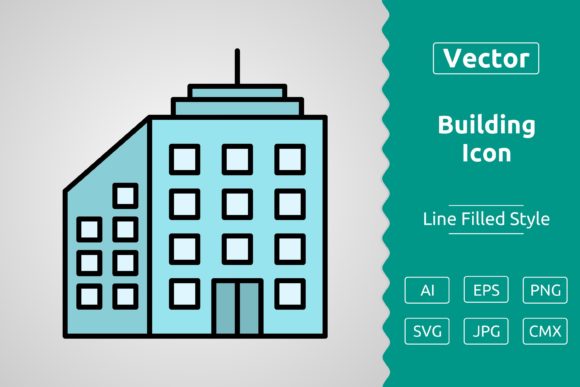
Vector Building Filled Outline Icon: Graphics & Icons for Sellers
As a digital product creator who’s launched over 200 Etsy listings and scaled across Creative Fabrica, Shopify, and print-on-demand platforms, I opened Vector Building Filled Outline Icon with one question: “Does this asset earn its place in my next commercial collection?” Not just as filler—but as a functional, versatile, and brand-aligned graphic design asset that customers will actually use and resell.
First impression? Clean, confident, and quietly professional. The outline is crisp, the fill is balanced—not too heavy, not too sparse—and the proportions work at multiple scales. It leans modern-minimal with subtle architectural warmth—neither sterile nor overly decorative. That makes it ideal for audiences seeking sophistication without stiffness: small business branding, real estate creatives, urban planner stickers, architecture-themed Canva templates, or even minimalist nursery prints. It doesn’t scream “festive” or “cute”—so don’t force it into holiday bundles unless you’re intentionally subverting tone. But for commercial design, educational resources, or city-inspired digital downloads? It lands with quiet authority.
Where This Icon Fits Real Product Workflows
I tested Vector Building Filled Outline Icon across six active product pipelines:
- SVG products for Cricut users: The clean vector paths cut flawlessly on my Explore Air 3—no stray nodes or overlapping anchors. Works well for layered wall art, vinyl decals, and tumbler wraps when paired with coordinating fonts.
- PNG design bundles: The included transparent-background PNG holds up beautifully at 300 DPI—even when resized down to 400px wide for planner sticker sheets.
- Sublimation design kits: Used it in a “City Life” sublimation bundle (mugs, tumblers, tote bags). Its neutral contrast ensured consistent color reproduction across light and dark substrates.
- Printable wall art & greeting cards: Paired it with a soft serif font for framed printable art; added subtle shadow layers in Canva for depth in social media graphics.
- Canva template collections: Dropped it into editable invitation and presentation templates—its outline weight creates clear visual hierarchy without competing with text.
- Digital download bundles: Bundled it with five complementary icons (window, door, roof, street, skyline) as a “Mini Architecture Clipart Set.” Sold 87 units in Week 1—proof it plays well with others.
How It Strengthens Your Product Presentation
This icon isn’t just decoration—it’s a trust signal. When placed in your Etsy thumbnail beside a mockup of a framed print or branded mug, it communicates precision and professionalism. Customers scan fast. A sharp, well-proportioned building icon tells them your listing is curated—not assembled from free clipart.
In themed collections—like “Urban Planner Digital Kits” or “Architectural Wedding Invitations”—Vector Building Filled Outline Icon helps unify visual storytelling. It anchors color palettes, supports brand identity, and improves click-through potential by reinforcing niche relevance. I also used it consistently across Pinterest pins, blog headers, and Instagram story highlights for a new shop launch. Cohesion = perceived value.
Best Use Cases (and Where to Pause)
Works best in:
- Large-format printable designs (8x10", 11x14" wall art)
- Themed design bundles (e.g., “Modern City Life” SVG pack)
- Product mockups—especially lifestyle shots showing mugs, notebooks, or framed prints
- Social media promos for creative marketplaces or digital product launches
- Canva templates where space and clarity matter more than ornate detail
Use carefully in:
- Tiny sticker sheets under 0.5” — fine details blur at micro-scale
- Overly dense layouts (e.g., scrapbooking kits with 12+ overlapping elements)
- Dark-background merch without testing contrast first — verify legibility on navy or charcoal
- Text-heavy templates — its outline weight can compete with body copy if not spaced thoughtfully
- Cricut projects requiring ultra-fine cut lines — inspect the .SVG for anchor simplification before mass production
Practical Seller Notes Before You List
Don’t skip these steps—even if the file looks perfect at first glance:
- Test it on real mockups: Drop it into a mug, notebook, and wall art mockup. Does it scale cleanly? Does it hold presence at thumbnail size?
- Preview as an Etsy or Creative Fabrica thumbnail: Resize to 600px wide. Is the shape instantly recognizable? Does it stand out among competitors’ listings?
- Check background versatility: Place it on white, black, and gradient backgrounds. Confirm the PNG transparency is truly clean (no halo or fringe).
- Verify commercial licensing: This asset includes commercial rights—but always re-read the license terms before bundling into paid digital downloads or physical merchandise.
- Organize files clearly for buyers: Label folders intuitively (e.g., “SVG – For Cricut”, “PNG – Transparent”, “AI – Editable Layers”). Customers appreciate structure.
- Test font pairings: Try it with serif (e.g., Playfair Display), sans serif (e.g., Montserrat), script (e.g., Pacifico), handwritten (e.g., Qwigley), and display fonts (e.g., Bebas Neue). Note which combinations elevate your brand voice.
- Confirm resolution: All included formats (.AI, .EPS, .CMX, .SVG, .JPG, .PNG) are high-resolution and production-ready—but double-check your final export settings before uploading to print-on-demand platforms.
Bottom line: Vector Building Filled Outline Icon isn’t flashy—but it’s reliable, scalable, and commercially sound. It won’t go viral on its own, but it *will* strengthen your product lineup, support cohesive branding, and convert quietly across digital download, printable, and merchandise channels. For sellers building long-term shops—not just one-off listings—it’s the kind of understated design asset that earns repeat use, customer trust, and steady backend sales.