Vector Stage Filled Outline Icon: Graphics & Icons for Creative Sellers
As a digital product creator who’s launched over 200 Etsy listings and managed seasonal collections across Creative Fabrica, Shopify, and print-on-demand platforms, I opened Vector Stage Filled Outline Icon with one question: “Does this asset earn its place in my next commercial bundle?” Not just as filler—but as a functional, versatile, and brand-aligned graphic design asset that customers will actually use and resell.
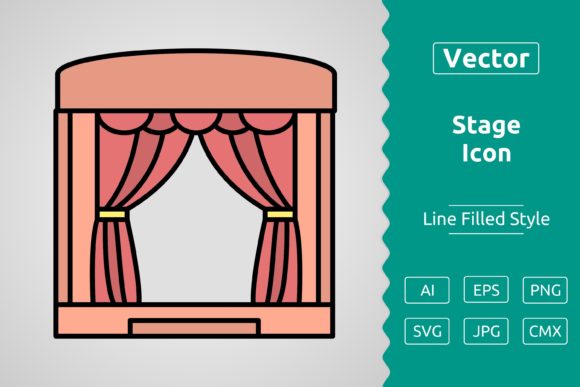
First impression? Clean, confident, and quietly intentional. The stage motif reads as both theatrical and symbolic—ideal for performers, educators, event planners, podcasters, or even motivational content creators. It leans modern-minimal rather than ornate or vintage, with balanced line weight, consistent stroke alignment, and generous negative space. It doesn’t scream “festive” or “cute”—it’s neutral enough for professional branding but expressive enough to carry visual storytelling. Think: a graduation announcement, a speaker’s social media kit, a classroom printable, or a boutique theater studio’s merchandise line.
The Download File Detail Zip File Included is exactly what it promises—and that matters. Inside, you’ll find six production-ready formats: high-resolution .AI and .EPS for vector editing, .CMX for CorelDRAW users, scalable .SVG for Cricut and Silhouette projects, crisp .JPG for quick mockups, and a transparent-background .PNG optimized for Canva templates, blog graphics, and digital paper packs. No upsells, no missing layers, no hidden rasterization. Just organized, labeled files—critical when you’re prepping 30+ assets for a themed bundle.
I tested Vector Stage Filled Outline Icon across real selling scenarios. For SVG products, the clean outline cut cleanly on my Cricut Maker—no stray nodes or overlapping paths. As a PNG design, it scaled beautifully on planner stickers and greeting card templates without pixelation. In sublimation design workflows, it held detail at 5” x 5” on mugs and tumblers. As part of a printable wall art collection, it paired well with serif fonts for elegance or bold sans serifs for a contemporary vibe. And yes—it worked in Canva template kits: dropped into invitation layouts, layered behind text blocks, or used as a subtle divider in digital planners.
Where it strengthens product presentation is often overlooked. On Etsy thumbnails, its strong silhouette reads instantly—even at 150px width. In product mockups (think t-shirt flat lays or framed nursery prints), it anchors the composition without overwhelming. When bundled with coordinating icons—microphones, spotlights, curtains—it builds visual hierarchy and perceived value. Customers trust consistency; seeing Vector Stage Filled Outline Icon repeated across your shop’s digital download listings signals professionalism, not randomness.
It shines brightest in large-format applications: printable posters, tumbler wraps, tote bag prints, and social media graphics where clarity and scalability matter. It also performs well in themed bundles—back-to-school teacher kits, graduation season collections, or creative entrepreneur starter packs. For packaging design or small business branding, it adds a subtle yet memorable touch to labels, thank-you cards, or digital receipt banners.
That said, there are smart limits. Avoid using it for ultra-fine sticker details—like 0.25” die-cut vinyl decals—where thin strokes may not hold during cutting or peeling. Don’t force it into overly complex scrapbooking kits with dense patterns; it loses impact. Skip dark backgrounds unless you’ve verified contrast—its outline relies on clear separation from the background. And if your product depends on precise cut lines (e.g., intricate Cricut iron-on layers), always inspect the SVG path in Design Space first—some converters add unnecessary anchor points.
Here’s how I vetted it before listing: I dropped it into three real mockups (a ceramic mug, a matte poster, and a Canva Instagram Story template), checked thumbnail visibility at 200px, previewed it on white and charcoal backgrounds, printed a test sheet at 300 DPI, confirmed the PNG had full alpha transparency (no gray fringing), and ran the SVG through a Cricut test cut. I also opened the .AI file to verify editable layers and grouped elements—crucial if buyers want to recolor or isolate parts.
For sellers organizing customer-facing files, I renamed each format clearly (e.g., “Stage_Icon_SVG_Cricut.svg”) and included a brief README.txt confirming commercial license compliance—because nothing erodes trust faster than ambiguous usage rights. I paired it with three font families in sample previews: a clean sans serif (Inter), an elegant serif (Cormorant Garamond), and a relaxed script (Pacifico)—proving flexibility without dictating style.
This isn’t a “one-off wonder.” Vector Stage Filled Outline Icon earns its keep across multiple revenue streams: as standalone clipart, embedded in digital paper packs, layered into t-shirt design bundles, or featured in seasonal Canva template shops. It supports visual storytelling for bloggers launching a new content series—or small business owners refreshing their brand identity. It’s not flashy, but it’s reliable. And in digital product creation, reliability converts.
If you sell printable designs, SVG designs, or commercial design assets on Etsy, Creative Fabrica, or your own Shopify store, this icon fits seamlessly into your workflow—no redesigns, no compatibility headaches. It’s the kind of quiet workhorse graphic design asset that helps your shop look curated, not cluttered. Test it early in your product development cycle. Use it where clarity and scalability matter most. And always—always—verify how it lands in your customer’s hands, not just your screen.