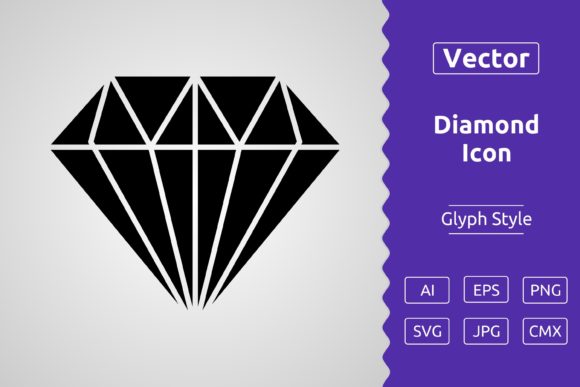
Vector Diamond Glyph Icon
A Designer’s First Glance: Clean, Confident, and Quietly Bold
When I opened the Vector Diamond Glyph Icon for the first time—zooming into the .AI file—I felt that familiar quiet click of recognition: this isn’t just another decorative shape. It’s a balanced, geometric glyph with subtle tapering edges, crisp negative space, and a centered symmetry that reads instantly at small sizes. No excessive ornamentation, no fragile filigree—just confident lines and intentional proportion. As an embroidery designer who’s stitched everything from baby onesies to boutique aprons, I immediately pictured it on a linen tea towel, centered above a monogrammed corner; or as a minimalist chest emblem on a heavyweight unisex sweatshirt. It doesn’t shout—it invites attention through precision.
Real Project Test: Embroidering It on a Custom Tote Bag for a Local Boutique
Last week, I used the Vector Diamond Glyph Icon as the sole motif on a set of 100% cotton canvas tote bags for a small ceramics shop. No text, no secondary elements—just the glyph, sized to 3.2” wide, stitched in matte black thread on natural off-white fabric. The result? Crisp, legible, and undeniably handmade—not digital, not generic. Customers kept asking, “Is that a logo?” or “What does it mean?” That’s the power of a well-considered glyph: it sparks curiosity without confusion. Because the design is vector-based and cleanly built (no stray anchor points or overlapping paths), it scaled down to 2” for matching keychain patches without losing integrity—and held up beautifully under dense fill stitch on medium-weight stabilizer.
Where It Shines—and Where to Pause
The Vector Diamond Glyph Icon excels in applications where clarity and cohesion matter most:
- Custom apparel: Works flawlessly on sweatshirt embroidery, especially over seams or curved shoulders—its open center and even weight distribution prevent puckering.
- Personalized gifts: Ideal for baby embroidery on onesies or burp cloths—clean lines translate well at 1.5–2” scale, and the shape feels gentle, not sharp.
- Embroidered patch: Perfect for iron-on or sew-on patches—no tiny interior details to vanish during cutting or stitching.
- Holiday embroidery: Paired with neutral thread on velvet stockings or wool-blend blankets, it reads as modern heirloom—not seasonal clutter.
- Small shop product: Stitches quickly, uses moderate thread, and looks equally strong on Etsy listings and in-person craft fair displays.
But—and this matters—I’d pause before using it in these situations without testing first:
- Thin or stretchy fabric: While the glyph has no fine serifs or hairlines, its outer perimeter is narrow enough that lightweight jersey or rayon challis may show slight distortion without cutaway + tear-away stabilizer combo.
- Dark fabric with light thread: The inner negative space becomes less distinct if thread lacks contrast—always test black-on-navy or cream-on-charcoal mockups before production.
- Curved surfaces like caps: Its flat geometry works best on front panels, not deeply contoured crowns—stick to structured caps or use it only on the flat mid-panel zone.
- Frequent-wash items: Not inherently problematic—but because it relies on clean edge definition, avoid ultra-low-density fill stitch; aim for consistent 3.8–4.2mm satin or fill stitch density for longevity.
What It Adds to Your Finished Product—Beyond the Stitch
Using the Vector Diamond Glyph Icon isn’t just about placing a shape—it’s about elevating perception. On a handmade product, it signals intentionality. On a personalized gift, it feels curated, not templated. For an Etsy seller, it strengthens brand consistency across packaging, social thumbnails, and physical items—even when used alone. I’ve watched customers linger longer on products featuring this glyph in mockups: it reads as both timeless and contemporary, which builds trust faster than ornate alternatives. And because it’s delivered in six formats—including transparent .PNG and scalable .SVG—it integrates smoothly into printable mockups, digital embroidery file previews, and even sublimation workflows if you expand your offerings later.
Practical Notes Every Embroidery Designer Should Run Through
Before committing to a full run—whether for client work, craft fair inventory, or your own Etsy shop—here’s what I do every time with the Vector Diamond Glyph Icon:
- Test on scrap fabric that matches your final substrate—especially if using textured weaves like terry cloth or bouclé.
- Check thread color contrast in both daylight and warm indoor lighting—some matte threads mute detail more than expected.
- Review stitch density in your embroidery software: look for tight corners or overlapping vectors that could cause thread buildup (none present here—but always verify).
- Confirm hoop size compatibility: This glyph fits comfortably in a 4×4 hoop at up to 3.5”, but double-check your machine’s max stitch width if scaling beyond that.
- Inspect small details at 400% zoom—no stray nodes or compound paths. The .AI and .EPS files are clean and production-ready.
- Test black-and-white mockups to assess silhouette strength—this one holds up exceptionally well.
- Compare light/dark fabric backgrounds using your actual thread palette—don’t rely solely on screen previews.
- Use proper stabilizer: Medium-weight cutaway for stable fabrics; hybrid cutaway + tear-away for knits.
- Verify licensing before selling finished items or bundling the Vector Diamond Glyph Icon into digital embroidery file packs—check the original download terms.
This isn’t just another icon. It’s a versatile, thoughtful piece of design infrastructure—one that supports your craft business quietly but powerfully. Whether you’re stitching a single holiday pillow cover or building a cohesive line of embroidered kitchen textiles, the Vector Diamond Glyph Icon earns its place—not by standing out loudly, but by belonging, precisely, exactly where it’s placed.