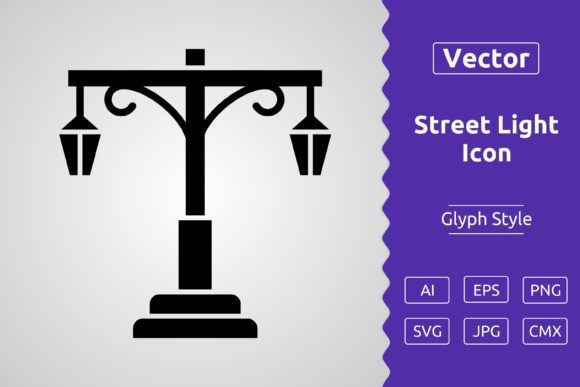
Vector Street Light Glyph Icon
A Clean, Quiet Statement — Not a Busy Decoration
When I first opened the Vector Street Light Glyph Icon, I didn’t see clutter or trend-chasing. I saw balance: a single upright post, subtle curve in the lamp arm, soft dome-shaped light source, and clean negative space around it. It’s minimalist but not cold — there’s warmth in its restraint. This isn’t a design that shouts; it murmurs thoughtfully. That makes it ideal for embroidery projects where subtlety builds trust: baby onesies, linen tea towels, boutique aprons, or unisex sweatshirts meant to age gracefully.
Real-Life Test: A Linen Tote Bag for a Local Bookstore
I used the Vector Street Light Glyph Icon on a natural linen tote for a neighborhood indie bookstore’s “Night Reading” collection. The icon stitched cleanly at 3.2" wide — large enough to read from across a café table, small enough to sit comfortably near the seam without distortion. Because the glyph is vector-based (and included in .AI, .EPS, .SVG), scaling was crisp — no pixelation, no jagged edges when resized for mockups or alternate placements. On the slightly nubby linen, the satin stitch cap of the lamp dome held its shape well, and the slender post stayed legible even with medium-density fill. Customers responded to its quiet confidence: “It feels like a promise,” one told me. “Like the light’s always on.” That kind of emotional resonance matters — especially for handmade products sold on Etsy or at craft fairs.
Where It Shines — and Where to Pause
The Vector Street Light Glyph Icon excels in applications where clarity and calm matter more than flash:
- Custom apparel: Works beautifully on cotton tees, fleece sweatshirts, and structured caps — especially when placed above a pocket or centered on the back yoke.
- Baby embroidery: Its smooth silhouette avoids tiny, risky details — no thin connectors or micro-loops that could snag or unravel after washing.
- Embroidered patch: Clean outlines translate directly into sharp, stable applique designs with minimal fraying risk.
- Holiday or wedding gifts: Fits seamlessly into neutral-toned nursery decor, monogrammed pillow covers, or linen kitchen towels gifted during housewarmings.
- Digital embroidery file use: The .PNG and .SVG files let you preview confidently in printable mockups — critical for Etsy sellers building cohesive listings.
But it’s not universally foolproof. Use caution on:
- Stretchy fabric (like ribbed knits) without proper cutaway stabilizer — the vertical line can skew if tension isn’t dialed in.
- Dark fabric with light thread — test contrast early. The glyph’s narrow profile means low-contrast combos (e.g., light gray on navy) may read as faint or incomplete.
- Curved surfaces like baseball caps — scale down to 2.5" or less, and avoid placing it over the front panel’s highest curve unless your machine handles dense satin stitch well.
- Tiny hoop sizes (< 4") — while scalable, the lamp dome and arm junction benefit from at least 3" of real estate to maintain proportion and stitch integrity.
What It Adds to Your Finished Product — Beyond Looks
Using the Vector Street Light Glyph Icon doesn’t just add decoration — it adds intention. Its visual quiet supports brand consistency for small shop owners who value cohesion over chaos. For craft business owners, it elevates perceived value: customers associate clean, considered icons with care and craftsmanship. On personalized gifts, it reads as meaningful rather than generic — think “first apartment keychain” or “graduation towel set.” And for digital product sellers, having six high-quality formats (.AI, .EPS, .CMX, .SVG, .JPG, .PNG with transparency) means you can offer layered mockup bundles or SVG-cut files alongside embroidery versions — expanding your digital embroidery file offerings without extra design work.
Practical Embroidery Designer Notes — Before You Stitch
This isn’t a “load-and-go” file — it’s a tool that rewards thoughtful prep:
- Test on scrap fabric first — especially if using textured weaves or blends. Note how the lamp dome fills and whether the post stays crisp.
- Check thread color contrast in natural light — what looks bold on screen may soften on fabric.
- Review stitch density in your embroidery software. If converting to a machine embroidery design, avoid overloading the lamp dome with unnecessary fill — a moderate satin stitch works best.
- Confirm hoop size matches your intended placement. A 5x7 hoop gives breathing room; a 4x4 requires tighter scaling.
- Inspect small details at 200% zoom — ensure no stray anchor points or overlapping paths exist in the vector layers.
- Test black and white mockups — this glyph’s strength lies in tonal balance, not color.
- Use appropriate stabilizer: medium-weight cutaway for knits, tear-away for stable wovens like denim or canvas.
- Verify licensing before selling finished embroidered items or bundling the digital embroidery file — the download includes formats suitable for commercial embroidery, but always confirm usage rights.
Final Thought: A Design That Lets the Maker — and the Moment — Lead
The Vector Street Light Glyph Icon won’t distract from your craftsmanship — it’ll support it. It’s the kind of icon that feels intentional on a handmade product, professional on a small shop’s branded item, and quietly special on a personalized gift. It doesn’t try to be everything. It’s simply, confidently, well-designed — and that’s exactly what busy embroidery designers, Etsy sellers, and creative entrepreneurs need more of: reliable, adaptable, human-centered Icons that serve the project, not the other way around.