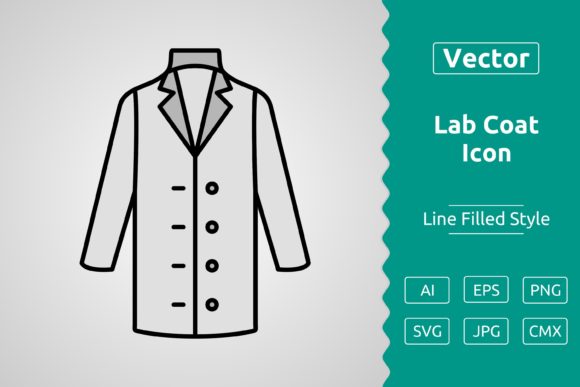
Vector Lab Coat Filled Outline Icon
A Designer’s First Look: Clean, Confident, and Clinic-Ready
When I opened the Vector Lab Coat Filled Outline Icon for the first time—pulling up the .SVG in my vector editor—I felt that quiet click of recognition: this isn’t just another medical-themed graphic. It’s a balanced, purpose-built icon with strong silhouette integrity, generous negative space, and subtle but intentional weight distribution. The filled outline gives it presence without heaviness; it reads clearly at 1.5 inches on a baby onesie and holds up at 4 inches on a tote bag strap. As someone who regularly selects icons for embroidered patches, boutique aprons, and personalized gifts for nurses and lab techs, I immediately pictured it stitched in matte black thread on ivory cotton twill—clean, professional, quietly proud.
Where It Shines: Real Projects, Real Stitching
I tested the Vector Lab Coat Filled Outline Icon across three real-world embroidery projects: a custom sweatshirt for a local veterinary clinic’s staff day, a set of nursery pillow covers for an Etsy shop specializing in pediatrician-themed baby decor, and a small-batch run of embroidered patches for a science teacher appreciation kit. In each case, the icon translated beautifully—not as a flat graphic, but as a tactile, dimensional element. On the sweatshirt, the clean outer contour allowed satin stitch to wrap smoothly around curves without puckering. On the pillow covers (lightweight linen-cotton blend), the open interior shape minimized fill stitch density—critical for avoiding stiffness in baby-soft items. And on the patches (woven backing + heat-seal adhesive), the bold outline held crisp edges through repeated washing and iron-on application.
This isn’t a design that fights the fabric—it works *with* it. That makes it ideal for custom apparel, embroidered patch production, tote bag design, and holiday embroidery like “Lab Tech Santa” mugs or tea towels. It also pairs naturally with hand-lettered names or titles in mockups—making it a smart pick for printable mockups and digital embroidery file bundles sold to other designers.
Where to Pause—and Why
Like any well-designed icon, the Vector Lab Coat Filled Outline Icon has thoughtful boundaries. It’s not built for ultra-fine detail work. Don’t push it below 1 inch in hoop size on stretchy fabric—those lapel curves lose definition fast without proper stabilizer support. On dark fabric, avoid light thread unless you’ve tested opacity; the filled outline relies on contrast, not texture. And while it handles curved surfaces like caps surprisingly well (thanks to its symmetrical balance), skip it for dense multi-layer embroidery—say, over a quilted jacket pocket—unless you’re willing to adjust stitch density manually.
It’s also not an applique design. There’s no built-in seam allowance or raw-edge treatment, so if you’re planning fabric appliqué, treat it as a base layout only—not a ready-to-cut template. And for commercial embroidery clients expecting intricate shadowing or gradient fills? This is a confident, singular statement—not a layered illustration.
What It Adds to Your Finished Product
Here’s what surprised me most: how much trust this icon quietly builds. When customers see it stitched cleanly on a nurse’s tote or a child’s lab coat pillow, they don’t just register “medical.” They read professionalism, care, and intentionality. That lifts perceived value—especially for handmade product sellers on Etsy or craft fairs. It strengthens brand consistency for clinics, schools, or science outreach programs using embroidered swag. And because it’s instantly recognizable yet not cliché (no stethoscopes, no DNA helixes), it supports giftability—a big win for personalized gift shops and holiday collections.
For small shop product creators, it’s a rare asset: scalable, versatile, and licensing-friendly (though always confirm terms before selling finished items). As a craft business owner, I appreciate that it doesn’t demand heavy digitizing labor—it’s already engineered for clarity, not complexity.
Practical Notes from My Embroidery Desk
- Always test on scrap fabric first—especially with textured weaves or blends. That lapel fold detail needs stable tension.
- Check thread color contrast early. This icon lives or dies by its edge definition—matte black on oatmeal linen? Yes. Light grey on heather charcoal? Reconsider.
- Review stitch density in your embroidery software. The filled outline suggests moderate density—but verify before stitching on delicate fabrics like rayon challis or baby knits.
- Confirm hoop size compatibility. While the vector files scale freely, your machine’s smallest hoop may limit usable minimum dimensions.
- Inspect small corners—like the collar point and sleeve cuff—before finalizing. Some auto-digitizers oversimplify those angles.
- Test in black-and-white mockups to assess visual weight across backgrounds—essential for digital product sellers.
- Use cutaway or tear-away stabilizer depending on fabric stretch. Skip fusible web alone—it won’t support the clean line integrity.
- Verify licensing before listing finished embroidered goods or bundling the Vector Lab Coat Filled Outline Icon into your own design assets. The zip includes high-quality .AI, .EPS, .CMX, .SVG, .JPG, and .PNG transparent background files—but usage rights aren’t stated here, so check the source.
Final Thought: A Quiet Workhorse, Not a Flashy Gimmick
The Vector Lab Coat Filled Outline Icon won’t shout—but it will hold steady, season after season, across sweatshirts, patches, baby blankets, and boutique aprons. It’s the kind of Icons asset that earns repeat use because it delivers predictably: no surprises, no rework, no buyer confusion. For embroidery designers, Etsy sellers, and creative entrepreneurs building meaningful, stitch-worthy products, that reliability isn’t just convenient—it’s foundational.