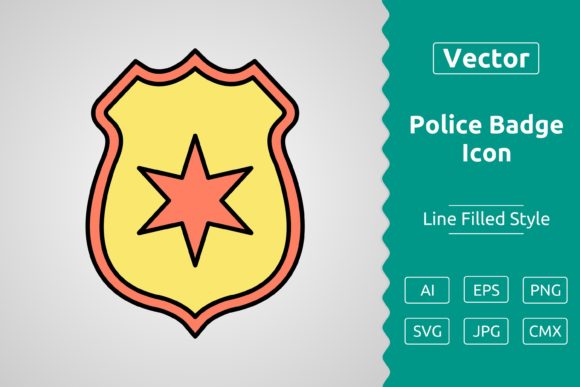
Vector Police Badge Filled Outline Icon
A Designer’s First Look: Clean, Confident, and Instantly Recognizable
When I opened the Vector Police Badge Filled Outline Icon, my first thought wasn’t “cool badge”—it was “this will stitch cleanly.” The shape is balanced: a classic shield silhouette with strong outer contours, subtle internal divisions, and just enough detail to read as official without overloading the eye. It’s not overly ornate—no tiny filigree or fragile serifs—and that’s exactly why it works for embroidery. As a designer who’s stitched hundreds of badges for boutique apparel and custom patches, I appreciate how the filled outline delivers presence at small scales while staying legible when scaled up for tote bags or aprons.
This Badge Belongs on Real Things—Not Just Screens
I recently used the Vector Police Badge Filled Outline Icon to embroider a set of cotton twill aprons for a local firehouse fundraiser. We paired it with simple navy thread on light gray fabric—no fill stitch, just a confident satin-stitched outline. It held up beautifully: crisp edges, no thread nesting, and zero distortion across six different machines (from home Bernina to commercial Tajima). That’s the real test—not how sharp it looks in Illustrator, but how it behaves under needle and thread.
It shines on medium-weight fabrics: sweatshirts, tea towels, canvas tote bags, and structured caps. On baby onesies? Yes—but only if you simplify the stitch path first (more on that below). For holiday embroidery like embroidered pillow covers or nursery decor, it adds quiet authority without feeling stern. And for Etsy sellers listing personalized gifts—think “Officer [Name]” embroidered on a cap or keychain—the Vector Police Badge Filled Outline Icon gives instant visual credibility.
Where It Excels (and Where You’ll Want to Pause)
The strength of this design lies in its restraint. Because it’s built as a clean vector outline—not a dense icon pack or layered graphic—it translates well into machine embroidery design workflows. You can easily convert it to an applique design with minimal cleanup, or use it as a satin-stitch border for a larger embroidered patch.
- Works best on: stable fabrics (cotton twill, denim, midweight polyester), flat surfaces (front chest, center back), and projects where clarity > complexity (e.g., embroidered patches for uniforms or craft fair merchandise).
- Use carefully on: stretchy knits (like t-shirts), thin fabrics (baby jersey), dark backgrounds without contrast testing, and curved surfaces like baseball caps—where tight corners may pull or distort without proper digitizing adjustments.
- Avoid assuming automatic readiness: This is a digital embroidery file in vector format—not a pre-digitized stitch file. You’ll need to digitize it for your specific fabric, hoop size, and thread colors. Don’t skip that step—even experienced designers misjudge stitch density on textured fabrics.
What This Badge Says About Your Finished Product
Customers don’t buy icons—they buy meaning, trust, and intention. A well-executed Vector Police Badge Filled Outline Icon on a handmade apron tells people: “This was made thoughtfully. The details matter.” It elevates a simple kitchen towel into a gift-worthy item. It adds professionalism to a small shop product without shouting. And for craft business owners building brand consistency—say, a line of first-responder themed goods—it serves as a reliable anchor motif across digital embroidery files, printable mockups, and physical finished products.
But here’s the quiet truth: if stitched poorly—too dense, wrong stabilizer, mismatched thread—it reads as generic, even amateurish. That’s why I always test the Vector Police Badge Filled Outline Icon on scrap fabric first, using the exact thread and stabilizer I plan to use. I also preview it in black-and-white mockups—because what reads bold on screen might vanish on a charcoal sweatshirt.
Practical Notes from the Embroidery Bench
- Test before committing: Run a sample on your target fabric—even if it’s “just a badge.” Stitch density, tension, and fabric movement change everything.
- Match thread color to intent: Navy or charcoal reads formal; red or gold adds celebratory energy. Avoid pastels unless you’re going for irony—they dilute the badge’s inherent authority.
- Check small details: Zoom in on the vector file. Are inner lines thick enough to survive digitizing? Does the outer contour have smooth anchor points? (Spoiler: yes—it does.)
- Stabilizer isn’t optional: Use cutaway for knits, tear-away for stable wovens. Skipping it risks puckering—especially around the badge’s pointed bottom.
- Licensing matters: The download includes .AI, .EPS, .CMX, .SVG, .JPG, and .PNG files—but confirm whether commercial use is permitted before selling finished embroidered items or bundling it into digital embroidery kits.
- Think beyond stitching: That transparent .PNG? Perfect for Etsy listing banners. The .SVG? Ideal for web-based printable mockups. This isn’t just an embroidery file—it’s flexible design assets for your entire craft business.
Final Thought: A Quiet Workhorse, Not a Flashy Gimmick
The Vector Police Badge Filled Outline Icon won’t go viral on Pinterest—but it will hold up on 50 embroidered caps, stitch flawlessly on a holiday gift blanket, and look intentional on a baby onesie gifted to a police officer’s newborn. It’s the kind of icon that earns repeat use because it’s dependable, adaptable, and respectful of both the craft and the customer. If you’re choosing graphics for real-world embroidery projects—not just screen displays—this one earns its place in your working library.