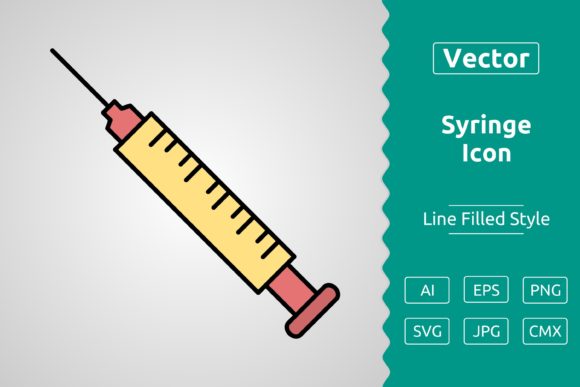
Vector Syringe Filled Outline Icon
A Clean, Clinical Pulse for Thoughtful Embroidery Projects
As a designer who’s stitched everything from baby onesies to boutique aprons—and reviewed hundreds of digital embroidery files—I opened Vector Syringe Filled Outline Icon expecting precision, not flair. What I found was exactly that: a crisp, minimal, single-line outline of a syringe, filled with subtle negative space rather than dense color. It doesn’t shout. It observes. It fits quietly into healthcare-themed merchandise, nursing graduation gifts, medical office decor, or even tongue-in-cheek wellness branding—but only if used with intention.
First Impressions: Simplicity That Stitches Well
The icon’s strength lies in its restraint. No gradients, no drop shadows, no ornamental flairs—just a balanced silhouette with proportional needle, barrel, and plunger. That clean vector structure translates directly to embroidery viability: sharp corners hold up under satin stitch, the open interior avoids overfilling, and the consistent stroke weight (roughly 1.2–1.5mm visually) gives reliable line definition at 2–3 inches wide. I immediately pictured it on a lightweight cotton tea towel for a nurse’s kitchen set—small enough to read, large enough to feel intentional.
Where It Shines: Real-World Embroidery Use Cases
- Custom apparel: On a charcoal sweatshirt cuff or chest pocket, Vector Syringe Filled Outline Icon reads clearly without overwhelming the garment. Its outline style avoids the “blob” effect common with heavy fill-stitch icons on textured fleece.
- Embroidered patches: As a standalone 2.5" patch for scrubs or lab coats, it stitches cleanly with low stitch density—ideal for iron-on backing and frequent laundering.
- Baby embroidery: On a soft organic cotton onesie, paired with a tiny stitched heart or stethoscope motif, it feels gentle and symbolic—not clinical or cold—when sized to 1.75" and stitched in pale mint or heather gray thread.
- Holiday & gift items: A stitched version on a linen pillow cover for a new med student’s graduation gift lands better than cartoonish alternatives—it signals pride, care, and quiet professionalism.
- Etsy & small shop products: As part of a coordinated set (e.g., matching tote + keychain + embroidered card), this icon anchors the collection visually without demanding attention. Customers recognize its purpose instantly—no explanation needed.
Where to Proceed With Care
This isn’t a one-size-fits-all embroidery file. Its elegance depends on context—and some surfaces test its limits:
- Small hoop sizes (under 3"): At 1.25", fine details like the plunger tip start to blur. Test stitch first; consider simplifying the tip or increasing minimum stitch length slightly.
- Stretchy or thin fabrics: On jersey or lightweight rayon, the outline can “swim” if stabilizer is undersized. Use cutaway + tear-away combo, and avoid hooping too tightly.
- Curved surfaces (caps, curved pockets): The straight barrel and angled needle work well on flat panels but may distort subtly on high-crown caps. Always do a test on a cap blank before committing.
- Dark or textured backgrounds: The outline relies on contrast. On black terry cloth towels or tweed aprons, opt for bright white or metallic silver thread—not ecru or charcoal—to preserve legibility.
- Dense decorative accents: Don’t pair it with heavy bullion or layered appliqué nearby. Let it breathe. It’s a supporting actor, not the lead.
What It Adds to Your Finished Product—Beyond the Stitch
Using Vector Syringe Filled Outline Icon thoughtfully elevates perception: it signals craftsmanship (clean lines = precise digitizing), trust (medical themes demand accuracy), and audience awareness (nurses, students, clinics respond to respectful representation). It avoids cliché while staying instantly recognizable—a rare balance in Icons. For Etsy sellers, that means higher perceived value per item; for craft fair vendors, it sparks conversation without needing signage. And because it’s delivered as true vector assets (.AI, .EPS, .SVG), you can scale it confidently for both a tiny lapel pin and a 4" tote bag design—no pixelation, no redraws.
Practical Designer Notes Before You Stitch
- Always run a test on scrap fabric matching your final project’s weight and stretch.
- Check thread color contrast in natural light—not just on screen—especially for personalized gifts where clarity matters most.
- Review stitch density in your embroidery software: aim for 10–12 stitches/mm for outlines; avoid auto-fill conversions unless you manually adjust density downward.
- Confirm hoop size compatibility—this design works best in 4x4" or larger hoops for optimal detail retention.
- Inspect corners and curves in your software preview; zoom to 400% to verify no stray nodes or overlapping paths.
- Test mockups in both black-and-white and grayscale—many buyers view listings this way, and the icon must remain legible without color cues.
- Use medium-weight cutaway stabilizer for woven fabrics, and fusible + tear-away for knits.
- Verify licensing terms before selling finished items or bundling this as part of a digital embroidery file pack—commercial use permissions vary by seller.
Final Thought: A Quiet Design That Earns Its Place
Vector Syringe Filled Outline Icon won’t go viral. It won’t dominate a tradeshow booth. But it will sit perfectly on a nurse’s embroidered tote bag—clean, confident, and quietly meaningful. It’s the kind of design that makes customers pause, nod, and say, “Yes—that’s exactly right.” For embroidery designers and creative entrepreneurs building thoughtful, niche-focused handmade product lines, that quiet resonance is worth more than flash. Use it with care, scale it with confidence, and let its simplicity speak for itself.